Choosing cybersecurity services for a construction firm is hard. Every provider says they protect, monitor, and respond fast, and most quotes sound the same on paper.
But construction risk is different from regular office IT risk. It lives inside consultant access, BIM file handovers, and payment approvals, and a generic comparison sheet usually cannot tell you whether a provider actually understands that.
So how do you actually tell the difference between providers, instead of guessing from a sales pitch?
That’s what this article will walk you through, starting with what you should be looking for in a provider, what actually separates a good one from a generic one, and what the cost difference really buys you.
Why Cybersecurity Services Matter in Construction?
Cybersecurity services matter in construction because project delivery depends on trust across systems that do not always move together. A breach does not need to shut everything down to cause damage.
For consideration, ASD’s ACSC reported over 84,700 cybercrime reports in FY2024–25, with average losses of $56,600 for small businesses and $97,200 for medium businesses, and construction representing 3% of reported sectors.
That 3% does not mean construction is low risk. It means exposure often sits inside fewer, higher-consequence workflows:
- In a 30-person builder, a compromised mailbox can alter invoice instructions.
- In a design-and-construct environment, stale consultant access can leave the team unsure who has seen the current package.
- In a BIM-enabled workflow, exported files can move faster than permissions or approvals are reviewed.
Once that happens, the problem shifts from cyber language into payment integrity, release confidence, and compliance risk.
What Cybersecurity Services for Construction Typically Include
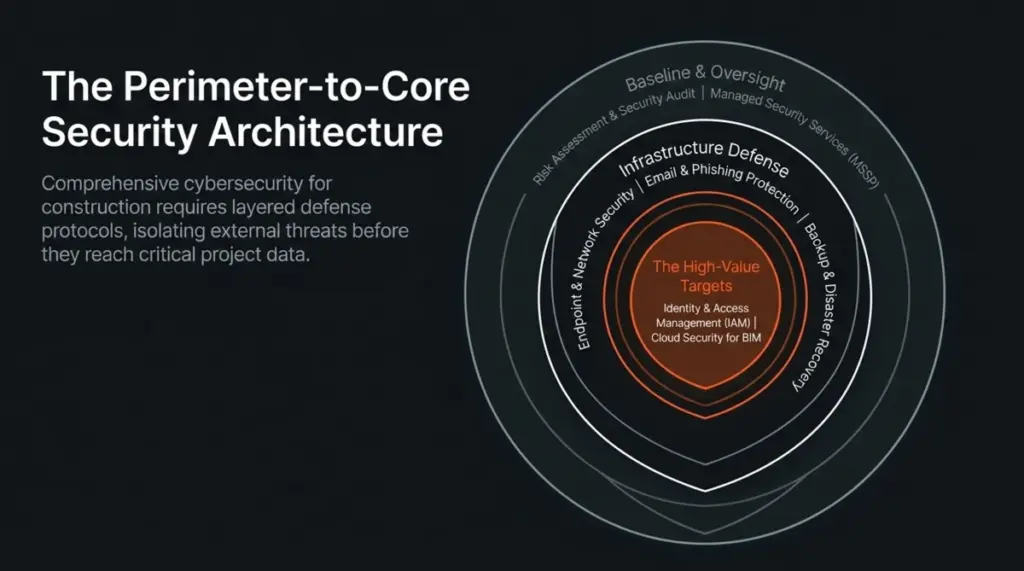
Cybersecurity support for Australian construction usually includes the controls that protect identities, endpoints, communication channels, cloud collaboration, and recovery paths. For example, each layer of cybersecurity best practices is below a discrete operational function to prevent unauthorised access. Let’s break down.
Risk Assessment and Security Audit
A risk assessment and security audit should identify where construction work is easiest to disrupt or lose control over.
A useful assessment does not stop at generic ratings. It should show which mailboxes control payment approval, which folders hold current project information, which external users still have access after a package or stage is complete, and which systems lack a clean recovery path.
In a 40-person firm, that often reveals more than a standard vulnerability summary:
- A subcontractor package may be finished, yet the account still has access to updated files.
- A director mailbox may carry both client communication and invoice approval.
- A project lead may still rely on emailed exports because the governed platform is not fully trusted.
Endpoint and Network Security
Endpoint and network security protect laptops, mobiles, shared devices, wireless networks, and the paths between office, site, and cloud systems. In construction, work rarely stays inside a stable office environment.
Shared site laptops, unmanaged phones, temporary connectivity, and devices moving between project locations all increase exposure. Once one device is compromised, the problem can spread into email, file access, collaboration tools, and finance approvals.
ASD’s Essential Eight remains one of the clearest Australian references for practical baseline control. Its framework includes patching, multi-factor authentication, restricted administrative privileges, and regular backups, and it is designed to be applied through a risk-based approach. That suits construction businesses that need staged uplift rather than a single large transformation.
Identity and Access Management (IAM)
Identity and access management controls who gets in, what they can see, and how quickly access changes when roles change. In construction, permissions often outlast the responsibility that justified them.
If a consultant retains access after delivery, they may still view or export updated information. The issue is not only that access remains. It is that the team can no longer confirm who is working from the current set, who still sits inside the approval boundary, or whether external visibility matches the project stage.
For example, Autodesk confirms that 2-step verification is available through Autodesk account security settings. That matters because BIM and project collaboration platforms now sit inside the identity boundary. They are not separate from it.
Cloud Security for BIM and Collaboration Tools
Cloud security for BIM and collaboration tools should protect access, external sharing, auditability, and account integrity across environments. Vendor security helps, but it does not correct weak operating behaviour inside the firm itself.
Autodesk states that its Construction Cloud security posture is supported through SOC 2 attestation and ISO 27001, ISO 27017, and ISO 27018 certifications. That supports the platform layer.
But please, it does not remove the need for permission reviews, MFA enforcement, controlled sharing, or cleaner handover discipline.
This is where generic cyber content usually stops too early. In construction, permission drift leads to outdated exports or parallel file sets. Parallel file sets lead to duplicated review effort. Once teams stop trusting the platform as the reference, coordination time shifts from decision-making to verification.
If the architect publishes through ACC while approvals, consultant exchanges, or last-minute clarifications keep moving through email and local copies, the risk sits in the handover points between systems.
Email and Phishing Protection
Email and phishing protection matter because email still carries invoice changes, consultant instructions, access resets, informal approvals, and director-level authority cues.
Today, a compromised mailbox does not need to deliver malware to create damage. Because it only needs to alter payment instructions or impersonate a decision-maker at the right moment.
ASD’s ACSC identifies business email compromise as a targeted form of phishing used to trick organisations into transferring money or releasing valuable information. Its FY2024–25 business fact sheet also shows email compromise was one of the top reported business cybercrime types.
So, email protection is not only filtering. It includes MFA, mailbox rule reviews, domain protection, conditional access, and a response process that assumes compromise can begin inside an ordinary-looking thread.
Backup and Disaster Recovery
As part of cybersecurity strategy, backup and disaster recovery should answer three operational questions clearly:
- What is protected?
- How fast can it be restored?
- What returns with the data?
In construction, the deeper issue is not just whether files come back after the data breach. If backup scope is unclear, recovery becomes selective. Teams may restore documents but lose confidence in version history, permissions, or the approval trace that shows what was current and who authorised it.
That is where many assumptions break. Microsoft states that Microsoft 365 Backup is a standalone pay-as-you-go service priced at $0.15 per GB per month. Its pricing is consumption-based, which makes one point clear: backup readiness is a scoped commercial decision, not an automatic inclusion.
Managed Security Services (MSSP)
Managed security services should combine telemetry collection, event correlation, identity monitoring, endpoint detection, and structured incident response. In construction environments, the value sits in how those signals are prioritised against operational context.
A finance mailbox compromise, an exposed BIM workspace, and a single infected endpoint generate different indicators across identity logs, access patterns, and endpoint behaviour. If these signals are not correlated and prioritised correctly, a response becomes noise-driven rather than risk-driven.
The issue is whether monitoring translates into action at the right control point.
If all alerts are treated equally, response effort spreads across low-impact events while high-impact risks tied to payment authority, project access, or approval integrity remain exposed.
How to Choose the Right Cybersecurity Solutions
The right cybersecurity solutions for construction firms are chosen by tracing how work actually moves across email, cloud platforms, finance approvals, and project environments, then testing how those flows are controlled and recovered under pressure. The strategy below shows how to assess a cybersecurity service provider around Australia:
- Identify where authority sits, including payment approvals, director access, and any mailbox or system that can trigger financial or contractual action.
- Map where current project information lives, such as drawings, models, and shared folders, and check whether teams rely on one governed source or multiple parallel versions.
- Review external access to confirm which consultants, subcontractors, or past contributors still have visibility into active environments.
- Define critical assets across Microsoft 365, finance systems, endpoints, and BIM or project platforms, and confirm how each is protected and monitored.
- Test whether the provider understands construction workflows such as consultant coordination, approval timing, and how information moves under delivery pressure.
- Check integration with existing tools so identity, email, endpoint, and cloud controls operate consistently rather than as separate layers.
- Assess how alerts are prioritised, including whether finance, project access, and endpoint risks are treated differently based on business impact.
- Review the support model to confirm how incidents are escalated, who responds, and how quickly control can be restored in live project conditions.
- Compare cost against exposure by identifying what remains uncontrolled in access, recovery, and compliance if the scope is reduced.
Specialised Cybersecurity Services vs General Providers
Specialised cybersecurity services differ from general providers in how they handle project-driven risk, external collaboration, and control points that sit outside standard office IT.
A general provider may still be suitable where the environment is mostly internal, tightly standardised, and lightly exposed to consultant access or live project-platform workflows.
| Factor | Specialised construction-focused provider | General provider |
| Core fit | Better aligned to environments where cyber risk touches project delivery, consultant coordination, drawing issue, and finance approval paths | Better aligned to environments where most risk sits inside standard business systems such as email, endpoints, and internal file access |
| Identity and access control | More likely to review external permissions, role drift, project-stage access, MFA coverage, and whether consultant visibility still matches delivery responsibility | More likely to focus on internal staff accounts, baseline MFA, and standard joiner-mover-leaver access without deeper project-stage review |
| BIM and project-platform coverage | More likely to treat ACC, BIM collaboration tools, SharePoint, Teams, and shared project data as part of one access and monitoring surface | More likely to secure each platform individually without fully addressing the handover points between project systems |
| Incident triage logic | More likely to prioritise incidents by delivery consequence, such as finance mailbox compromise, exposed project workspaces, or unauthorised visibility into current information | More likely to prioritise by alert severity alone, which can flatten the difference between business-critical and lower-impact events |
| Monitoring relevance | More likely to correlate identity events, external sharing changes, suspicious mailbox activity, and project-platform access patterns against live delivery risk | More likely to monitor common security signals well, but with less context around project roles, consultant behaviour, or release timing |
| Recovery design | More likely to consider not just data restoration, but also permissions, current-set confidence, approval trace, and who regains access after recovery | More likely to focus on restoring system availability and file access without the same emphasis on release control or project-stage auditability |
| Commercial risk fit | Stronger where one compromised account or exposed workspace can affect payment integrity, client trust, approval confidence, or coordination reliability | Stronger where the main priority is broad baseline coverage across a simpler and more internally contained environment |
The difference above matters when your project delivery depends on external collaboration, like:
- If your business operates mostly inside Microsoft 365 with limited outside access, a general provider may be enough.
- If delivery depends on current drawings, consultant visibility, shared models, project-platform access, and fast approval cycles, the provider needs to understand how those handover points affect both cyber exposure and delivery control.
Cost of Cybersecurity Services for Construction Firms
The cost of cybersecurity for Australia’s construction industry really depends more on scope than on one public market rate, so there is no single number. That’s why we suggest, as buyers, you should separate three cost layers:
- The security software layer
- The backup and recovery layer
- The managed service layer.
The software layer is the easiest to verify simply because you see the pricing on the software’s official website as a comparison. For example, Microsoft Business Premium is listed at AU$32.90 per user per month paid yearly, excluding GST. Microsoft 365 Backup is listed at $0.15 per GB per month.
The managed service layer depends on user count, device count, monitoring coverage, incident response expectations, access cleanup, and the amount of policy and governance work required.
That’s why the better buying question is not, ‘What is the cheapest cyber package?’
The better buying question should be: what gap remains in email authority, recovery, access control, and compliance if we choose the cheaper scope?’
That question comes from the reality that a single compromised account can create more financial and operational damage than the annual cost difference between a lean baseline and a properly managed service.
Get Expert Support for Construction Cybersecurity
Across every layer of construction cybersecurity, the real risk stays the same. Access, approvals, and recovery stop behaving the way you expect, and by the time that becomes obvious, your finance authority, project visibility, and coordination are already exposed.
Cybersecurity services for construction firms is one of Redscale’s specialisations, and we approach it around that exact problem. We align access to roles and project stages instead of leftover permissions.
We prioritise alerts by what they actually put at risk, including payment exposure and project access, not just system severity. We design recovery to bring back permissions, version integrity, and approval trace, not only the files, so your team keeps delivering without rebuilding trust manually.
Contact us for cybersecurity built around how construction projects actually run.