For Australian startups, SaaS companies, digital businesses, and mid-market organisations, the Essential 8 vs SMB1001 debate is a question about evidence.
For example, a growing business may be asked to prove MFA, backups, patching, administrator access controls, endpoint protection, email security, and incident response ownership before a contract moves forward.
Cyber insurance renewals can ask similar questions. So can supplier reviews, tenders, board discussions, and enterprise procurement teams.
The pressure usually lands on someone inside the business who has to gather evidence, explain gaps, and keep controls current. That person may be a founder, operations lead, IT manager, finance leader, or outsourced security partner.
The Essential 8 helps businesses speak in the language of Australian technical maturity, while SMB1001 gives smaller organisations a staged certification pathway.
The best choice is the one your business can implement, maintain, and defend when someone asks for proof. In this article, we’re going to break down the difference and how to choose the best fit for your business.
Essential 8 vs SMB1001 at a Glance
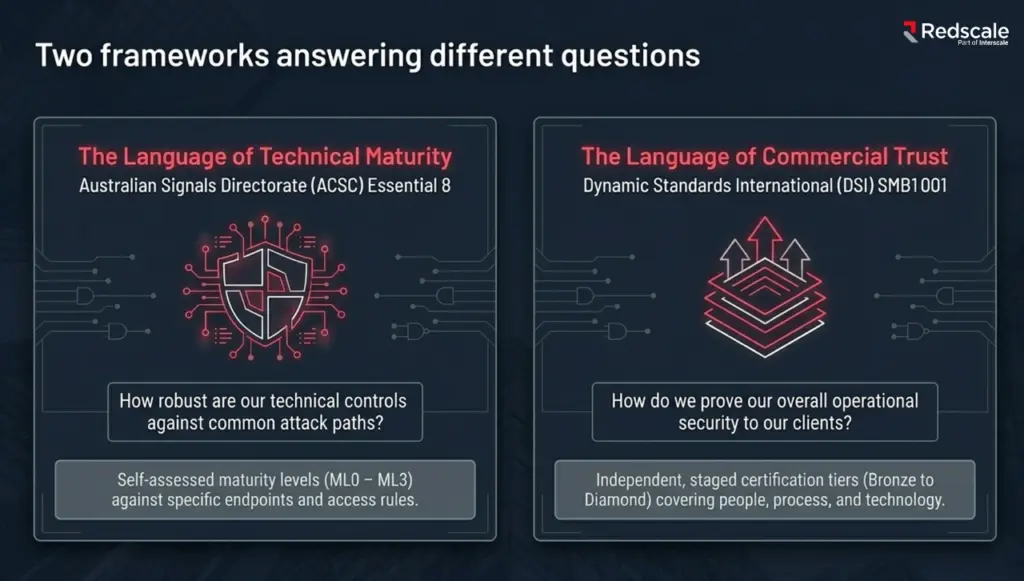
The Essential 8 vs SMB1001 debate comes down to whether your business needs to prove technical control maturity, staged cybersecurity certification, or both. The table below shows the comparison of Essential 8 vs SMB1001 at a glance.
| Comparison point | Essential 8 | SMB1001 |
| Publisher | ASD / ACSC | Dynamic Standards International |
| Main purpose | Reduce common attack paths | Certify SMB cyber maturity |
| Best fit | Government and regulated buyers | SMBs needing client assurance |
| Core structure | 8 mitigation strategies | 5 certification tiers |
| Main control focus | Patching, MFA, admin access, backups | Access, backups, policies, training |
| Assurance style | Maturity-based assessment | Tier-based certification |
| Evidence usually needed | Control maturity and artefacts | Tier evidence and attestation |
| Buyer relevance | Strong when Essential 8 is specified | Useful when certificates are accepted |
| Commercial use | Tender and regulated-sector proof | Client and insurer-facing proof |
| Implementation challenge | Matching the right maturity level | Maintaining controls after certification |
| MSSP relevance | Close control and evidence gaps | Prepare and maintain certification evidence |
| Common risk | Claiming alignment without maturity proof | Treating the certificate as the finish line |
What Is the Essential 8?
The Essential 8 is an Australian cybersecurity baseline from ASD’s ACSC, which focuses on eight mitigation strategies that help reduce common ways attackers compromise internet-connected systems.
The Essential 8 matters because it is already familiar in government, defence, critical infrastructure, and larger enterprise security conversations. As a government concept, the Essential 8 often becomes most commercially visible when larger Australian buyers use it in supplier requirements.
That is why the wording matters. A buyer asking for “alignment with the Essential Eight” may expect maturity evidence, control status, exceptions, and remediation plans.
The Eight Mitigation Strategies
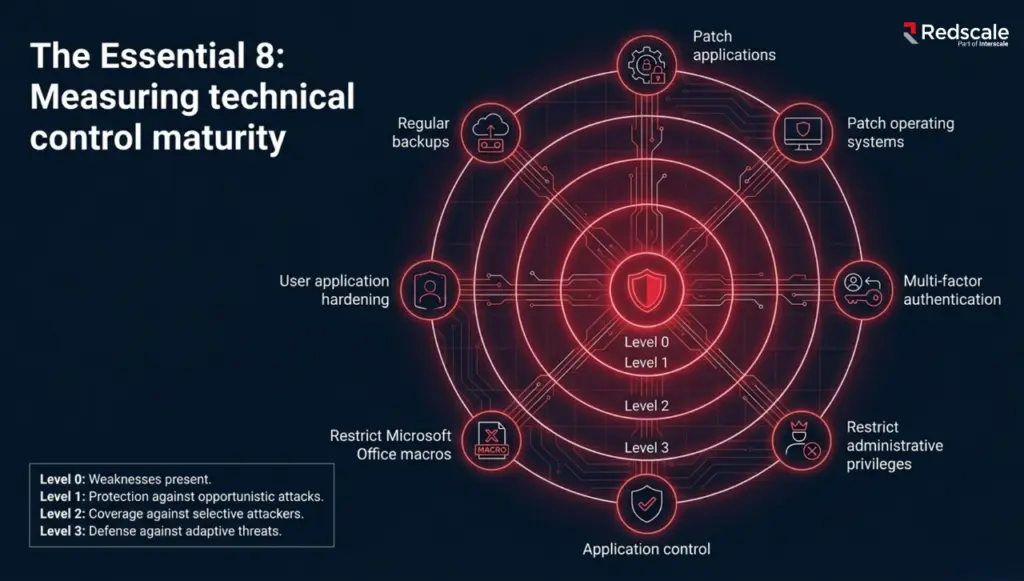
The eight mitigation strategies are the practical centre of the Essential 8, which includes:
- Patch applications
- Patch operating systems
- Multi-factor authentication
- Restrict administrative privileges
- Application control
- Restrict Microsoft Office macros
- User application hardening
- Regular backups
They focus on common security weaknesses such as unpatched systems, weak authentication, over-privileged accounts, unsafe macros, and poor recovery capability.
These controls look simple when listed. In a real enterprise-level business environment, these controls usually touch cloud identity, SaaS applications, endpoint devices, staff workflows, privileged accounts, finance platforms, customer systems, and backup coverage.
For SaaS and digital businesses, this may include Microsoft 365 or Google Workspace admin roles, developer accounts, CRM access, payment systems, cloud hosting consoles, and accounting platforms. The dilemma is what often gets missed is the coverage, like:
- A business may have MFA on email, but not on administrator accounts.
- Your business may have backups, but no recent restore test.
- Your business may restrict admin access in theory, but still keep shared accounts for convenience.
How Maturity Levels Work
Essential Eight maturity levels work by assessing how consistently each mitigation strategy is implemented, evidenced, and maintained across the business.
That assessment is then expressed as a maturity level, so the business can see whether its controls are still weak, partially developed, or more consistently managed.
ASD defines the model from Maturity Level Zero through to Maturity Level Three, with each level reflecting a stronger security posture. Here is the simple way to read the model:
- Maturity Level Zero means weaknesses are still present. The organisation has gaps in its current approach, so the controls are not yet strong enough to meet Level One.
- Maturity Level One focuses on common attack methods. This level is designed to reduce exposure to common, opportunistic attacks that many SMBs are more likely to face.
- Maturity Level Two expects stronger control coverage. This level is more relevant when the business may face more selective attackers, stricter clients, or stronger supplier requirements.
- Maturity Level Three is designed for more adaptive threats. This level expects a stronger and more consistent security posture across the mitigation strategies.
The important point is specificity. Saying the business uses the Essential 8 is not a strong answer if a client asks for a maturity level. A better answer names the target maturity level, shows the current status of each strategy, explains any exceptions, and gives remediation dates for gaps.
What is SMB1001?
DSI describes SMB1001 as a tiered cybersecurity certification standard designed to help small and medium businesses improve and demonstrate their security maturity.
It gives businesses a staged pathway from foundational controls to higher assurance levels, instead of forcing every organisation into the same compliance depth from the start. For Australian SMBs, that staged model can make cyber maturity easier to plan, evidence, and explain.
SMB1001 is relevant when your client, insurer, or partner wants proof that basic cybersecurity controls are in place. The certificate can support that conversation, but its value depends on whether the receiving party accepts the tier, scope, and assurance model behind it.
For a fuller explanation, see RedScale’s guide on what SMB1001 is.
The Five Pillars
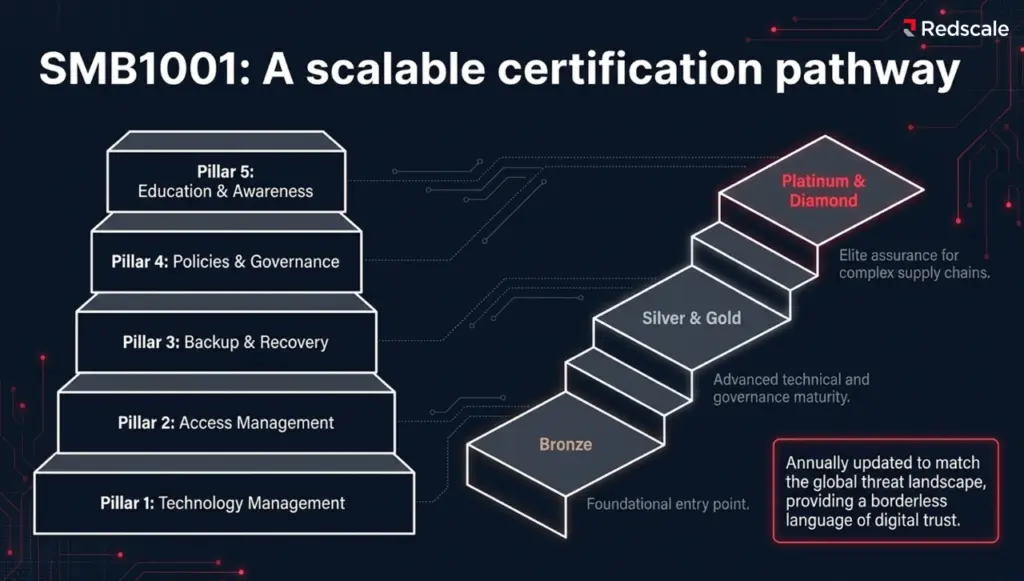
The five pillars give SMB1001 its operating structure, which commonly discussed as:
- Technology management
- Access management
- Backup and recovery
- Policies and governance
- Education and awareness
They help a business organise cyber security work across technology, access, recovery, governance, and people. The value of the SMB1001 five pillars is that each pillar creates an ownership question, like:
- Who manages devices?
- Who approves access?
- Who tests recovery?
- Who updates policies?
- Who confirms staff have understood the rules?
This is where smaller businesses often find the real gap. A control may exist, but no one owns the evidence. A policy may exist, but no one reviews it. A backup may exist, but no one has tested whether the business can restore from it.
Bronze to Diamond Certification Tiers
SMB1001 uses five certification tiers: Bronze, Silver, Gold, Platinum, and Diamond. These tiers help your business to start at a realistic level and improve over time. Let’s break down the SMB1001 tier:
- Bronze is the entry point
- Silver and Gold build more maturity across technical and governance controls
- Platinum and Diamond are higher assurance tiers that may suit businesses with stronger client, regulatory, or supply chain expectations.
The tier matters because not every certificate carries the same assurance weight. A buyer, insurer, or partner may ask what tier was achieved, what scope was covered, and what evidence supports the result.
Key Differences That Matter for SMBs
The key differences between Essential 8 and SMB1001 that matter for SMBs are audience fit, control scope, assurance model, and the cost of proving and maintaining evidence.
Each difference shapes how clearly your business can answer the next buyer question, from maturity level to certification scope, control evidence, insurance review, and ongoing ownership.
Target Audience and Design Intent
The Essential 8 is designed as a set of prioritised mitigation strategies for broader Australian organisations, while SMB1001 is designed with SMBs in mind. Also, the Essential Eight can support technical maturity language, while SMB1001 can support staged external assurance.
That’s why the Essential 8 has strong relevance where government, defence, regulated sectors, or enterprise buyers expect maturity-based language. While the SMB1001 tiered model gives smaller organisations a clearer ladder from basic controls to stronger assurance. For usage example:
- For a 25-person SaaS company selling to private-sector clients, SMB1001 may be easier to explain.
- For a business selling into government or a defence-adjacent supply chain, the Essential 8 may need to lead the conversation.
- For a 70-person digital business with enterprise clients, the answer may be both.
Scope of Protection
The Essential 8 focuses on eight technical mitigation strategies, while SMB1001 has a broader business-facing shape.
The Essential 8 strength is depth across controls that attackers often exploit, including patching, MFA, administrator access, application control, macro restrictions, hardening, and backups. The SMB1001 can bring technology, access, backup, policy, governance, and education into one staged certification pathway.
But neither framework should be treated as a complete cybersecurity programme by itself. A growing business may still need email security, endpoint monitoring, incident response planning, vulnerability management, supplier risk review, and security awareness work.
That is where MSSP support becomes relevant to help your business to keep monitoring, remediation, escalation, reporting, and evidence moving after the first assessment.
Certification vs Self-Assessed Maturity
The Essential 8 does not automatically provide a certificate, but SMB1001 is different because it is structured around certification
ASD states that independent certification is not required unless a government directive, policy, regulator, or contract requires assessment. While SMB1001 provides certification because it can be useful when a business needs something more visible than an internal maturity statement.
This difference can matter in sales and procurement conversations. A procurement team may ask for an Essential Eight maturity position, supporting artefacts, or an assessment method. A private-sector client may prefer a SMB1001 certificate it can record in a supplier file.
Cost and Time to Certify
Cost and time depend more on your current environment than the framework name. A business with managed devices, enforced MFA, tested backups, documented policies, and clean administrator access will move faster than a business starting from informal practices.
For the Essential 8, the main cost is usually implementation and assessment effort, while for SMB1001, costs may include certification fees, gap assessment, remediation, tooling, policy development, evidence preparation, and ongoing support. The certificate may be only one part of the total investment.
The Essential 8 work costs may include patch management, identity configuration, application control, macro policy, device hardening, backup testing, and evidence collection.
For SMB1001, costs may include certification fees, gap assessment, remediation, tooling, policy development, evidence preparation, and ongoing support.
What do Insurers, Clients, and Tenders Actually Say About Essential 8 vs SMB1001?
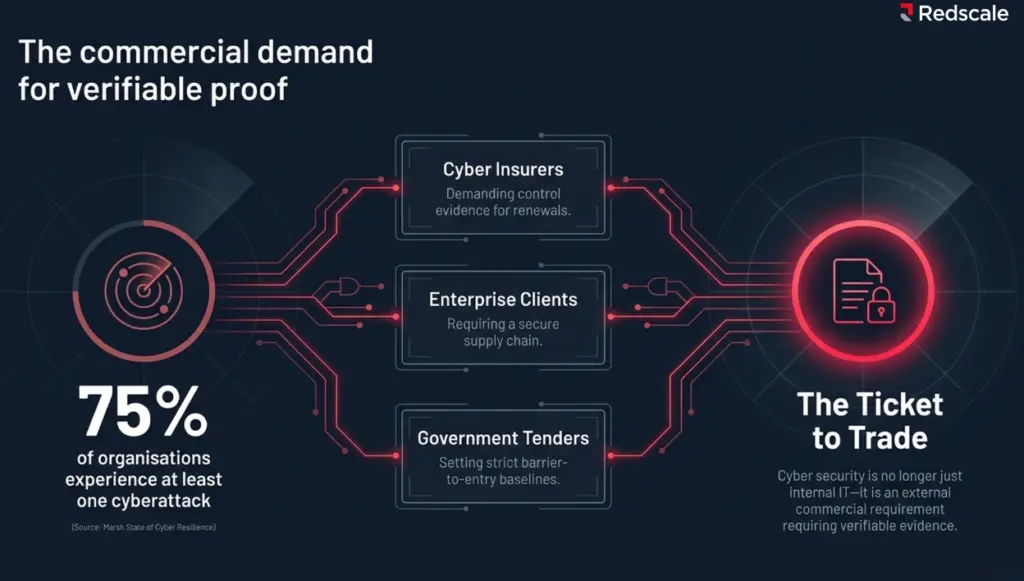
Insurers, clients, and tenders usually ask whether specific cyber controls are in place, whether evidence is available, and whether Essential Eight maturity or SMB1001 certification is accepted for their review.
Those questions rarely arrive in the same format, so the practical task is to understand how each audience translates cyber assurance into its own review language.
The wording changes by audience, and the pattern stays consistent: broad assurance questions usually lead to specific control checks.
Insurers
Cyber insurance proposal and renewal forms commonly ask about MFA, backups, endpoint protection, email filtering, incident response, governance, and prior incidents.
The request is usually evidence-based: policy records, configuration screenshots, backup test results, endpoint coverage reports, or incident response plans.
SMB1001 can help structure those answers, although certification should not be presented as a guaranteed path to lower premiums or automatic approval.
Clients
Client security reviews usually ask whether the business can protect customer data, restrict access, recover from incidents, and maintain core security controls.
Enterprise buyers may ask for Essential Eight maturity when they have government, defence, regulated-sector, or higher-risk supply chain exposure.
SMB1001 may be useful in SMB-to-SMB or mid-market deals where certificate-backed assurance is accepted as part of supplier review.
Tenders
Tender requirements usually matter because the wording is specific. Some government and defence-related tenders may name Essential Eight maturity levels, while private-sector supplier reviews may ask for cyber assurance more generally.
The safest response is to match the framework to the tender wording, then prepare supporting evidence for follow-up questions.
For businesses handling customer personal information, these evidence requests also support breach readiness. However, the issue is how quickly the business can detect, contain, assess, explain, and document an incident.
CCP Australia has warned against overstating what SMB1001 proves in the Australian market, especially around insurance premium claims. That is a sensible position for buyers and MSSPs to follow.
Do Australian Businesses Need Both Frameworks?
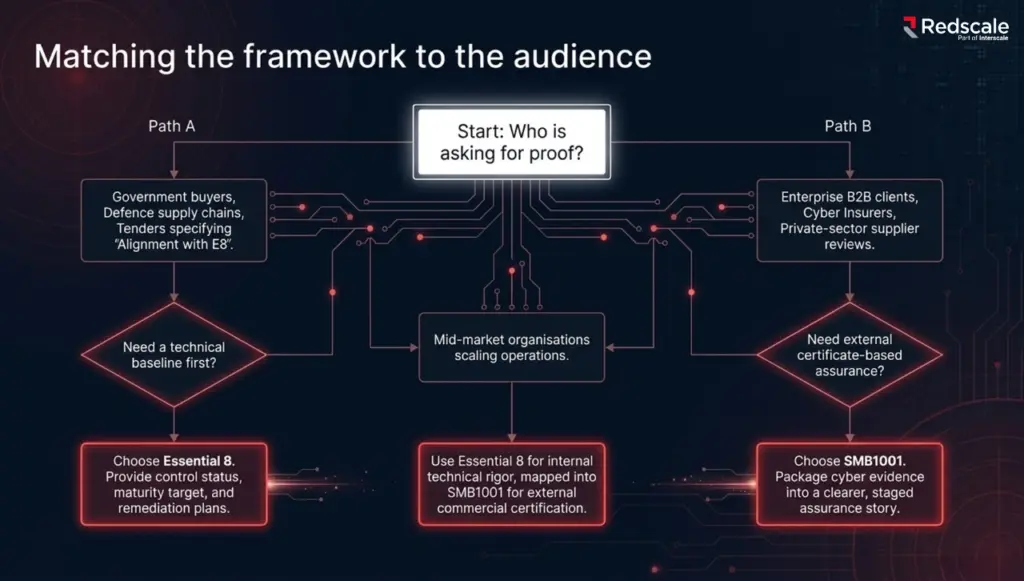
Australian businesses may need both frameworks when they serve different evidence purposes. The Essential 8 can guide technical maturity, while SMB1001 can help package cyber maturity into a staged certification pathway.
The clearer choice appears when you look at who is asking for proof and what they expect to see next.
Choose the Essential 8 If
Choose the Essential 8 if the request names Essential Eight maturity, government supply chain expectations, defence-related requirements, or a specific technical control baseline.
Use the checklist below to see when the Essential 8 should lead the conversation:
- You sell into government
- You support a defence supply chain
- A tender specifies an Essential Eight maturity level
- Your sector expects Australian technical maturity language
- Your internal team can assess and maintain control evidence
- You need a technical baseline before broader assurance
This route can be more demanding than it first appears. Then the challenge is proving that each control works at the required maturity level.
We suggest the starting point is to identify the maturity level requested, map each mitigation strategy, record gaps, and assign remediation owners.
Choose SMB1001 If
Choose SMB1001, especially the 2026 version, if the request calls for certificate-based assurance, staged cyber maturity, private-sector supplier confidence, or a practical pathway your business can explain externally.
Use the checklist below to see when SMB1001 should lead the conversation:
- You need certificate-based evidence for private-sector clients
- You do not have an in-house security team
- You want a clearer roadmap from basic controls to stronger maturity
- You need to support cyber insurance conversations
- You want a supplier credibility signal that is easier to explain
- Your directors need a structured way to understand cyber responsibility
Before relying on the certificate externally, confirm whether the client, insurer, or tender panel accepts SMB1001 and which tier they expect.
But the certificate should not be treated as the finish line. It should be treated as a way to organise controls, clarify ownership, and keep evidence ready for the next client or insurer conversation.
Get SMB1001 Certified With RedScale
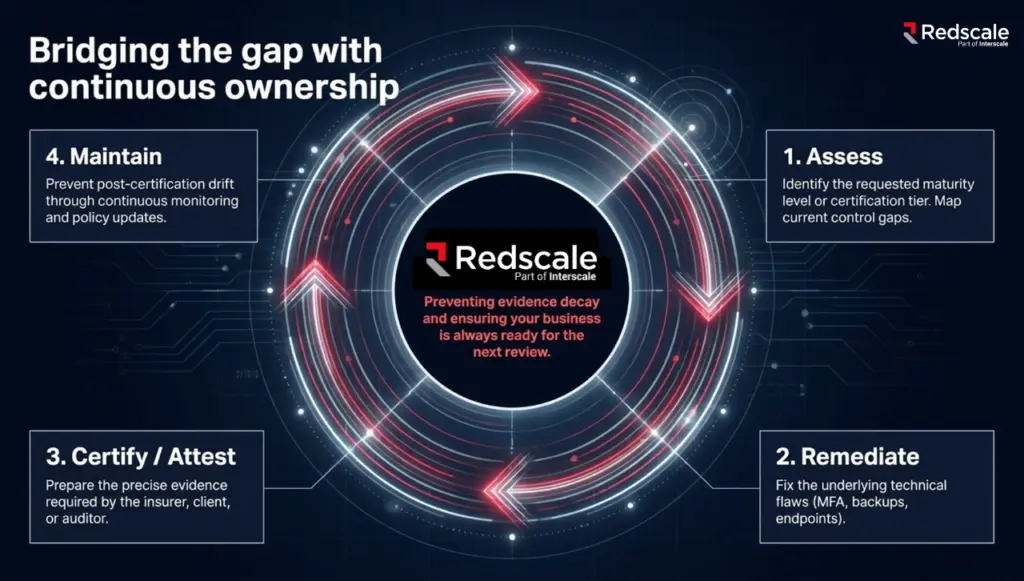
SMB1001 certification gives your business an evidence target. The real work is keeping that evidence reliable after the first review.
RedScale helps Australian startups, SaaS companies, small digital businesses, and mid-market organisations prepare for SMB1001 certification with practical security support.
RedScale provides SMB1001 Certification Support Australia businesses that want guided support through the SMB1001 pathway. The service can help assess your current position, identify gaps, prepare evidence, support remediation, and keep controls maintainable after certification.
That support matters when evidence depends on live security controls such as MFA, backups, endpoint protection, access reviews, policy records, and incident escalation.
Book a discussion with RedScale and get ahead of what clients, insurers, and tenders will ask for.