Managed security services are outsourced cybersecurity operations. An MSSP, the specialist provider that does this work, handles monitoring, detection, response, and reporting instead of an in-house team.
But knowing what an MSSP does doesn’t tell you if your business needs one. Most SMBs already run some security tooling and can’t tell if it’s enough or if the gaps are worth outsourcing.
That evaluation gets harder once you start comparing it with another term and another abbreviation like MSPs or MDRs, and even harder when you start pricing out what the service costs.
If you’ve been wondering about that, you’ve come to the right place.
Because today, in this article, we are going to break down what managed security services include and how it compares to MSP and MDR. It also covers whether your business needs one and what it costs in Australia.
What are managed security services?
Managed security services are outsourced cybersecurity services that help a business operate and improve its security controls. They are usually delivered by a managed security service provider, or MSSP, that combines security people, process, tooling, monitoring, response, and reporting.
For buyers, the important point is that managed security is not only software. It is ongoing security ownership.
For an Australian SMB, “managed” should mean agreed responsibility, regular review, clear escalation, and practical advice when something needs action.
What Does a Managed Security Service Provider (MSSP) do?
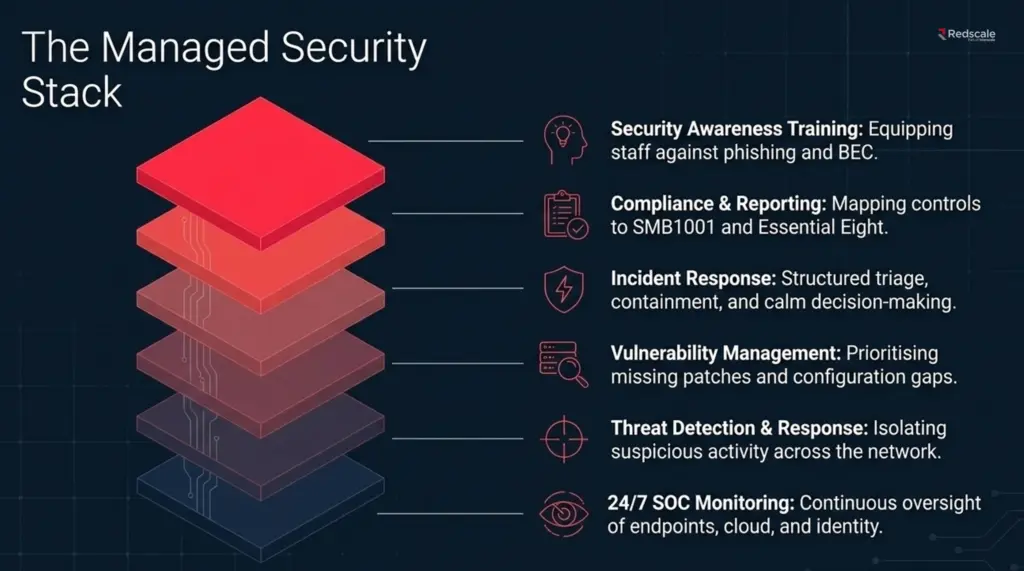
A managed security service provider manages defined cybersecurity activities for a business, usually across:
- Monitoring
- Detection
- Response
- Vulnerability management
- Compliance support
- Staff awareness.
The exact scope depends on the business, so responsibilities should be clear before the service starts. Let’s break down each variable.
24/7 Monitoring Through a Security Operations Centre (SOC)
An MSSP watches your systems 24/7 continuously from a security operations centre (SOC), a dedicated facility staffed by security analysts. This matters because account compromise, phishing, malware, and suspicious sign-ins do not wait for Monday morning.
Where included in scope, a SOC may monitor signals from endpoints, Microsoft 365, identity systems, email security, cloud platforms, and network tools.
Analysts then triage alerts and decide whether the activity is noise, suspicious behaviour, or a confirmed incident.
Then what happens after the alert?
Threat Detection and Response
Threat detection and response means the MSSP looks for suspicious activity and helps contain or escalate it. This turns security tooling into an operational service.
Examples may include unusual logins, impossible travel alerts, malware behaviour, phishing activity, endpoint compromise, privilege misuse, or suspicious data access.
Depending on the agreement, the MSSP may investigate, isolate devices, disable accounts, or guide your internal team.
The service also needs tuning. Without tuning, a small team can be flooded with false positives and start ignoring alerts.
Vulnerability Management
Vulnerability management is the ongoing process of finding and fixing weaknesses before attackers exploit them. So, an MSSP scans your systems regularly for outdated software, misconfigurations, and known security gaps.
The problem with most SMBs is that they struggle because the data is too noisy. Therefore, MSSP should help separate internet-facing risks, critical business systems, unsupported software, and urgent patching from lower-priority items.
This is where practitioner judgement matters. Not every finding deserves the same urgency, and not every fix can happen on the same day.
The provider should help your team decide what to fix first and what can wait with accepted risk.
Incident Response
Incident response is the structured process an MSSP follows when a security event is suspected or confirmed. The value of MSSP incident response is speed, structure, and calm decision-making.
As you might expect, delayed detection can increase the cost and disruption of an incident, so a practised response process helps the business act before the situation spreads.
Support may include triage, containment advice, evidence collection, recovery guidance, and post-incident recommendations.
The service scope matters here. MSSP incident response is not always the same as full legal, privacy, regulatory, or forensic breach management unless those activities are included or separately arranged.
Compliance Support and Reporting
Compliance support helps your business meet the security standards your industry or customers expect.
An MSSP maps your controls against frameworks such as the Essential Eight or SMB1001, then reports on where you stand.
Reports may support customer questionnaires, cyber insurance reviews, board updates, supplier due diligence, and internal planning.
For Australian SaaS and digital businesses, this evidence can matter when a larger customer asks how access, logging, patching, backups, and incident response are handled.
Security Awareness Training
In the security awareness training area, the MSSP helps your staff recognise and report common cyber risks. It should be practical, relevant, and easy for busy teams to follow.
For Australian SMBs, this often includes phishing, business email compromise, MFA prompts, password hygiene, invoice redirection, suspicious attachments, and safe file sharing.
The best training connects directly to the way the business works. Training should also explain what staff report, where they report it, and what happens next.
How do Managed Security Services Work?
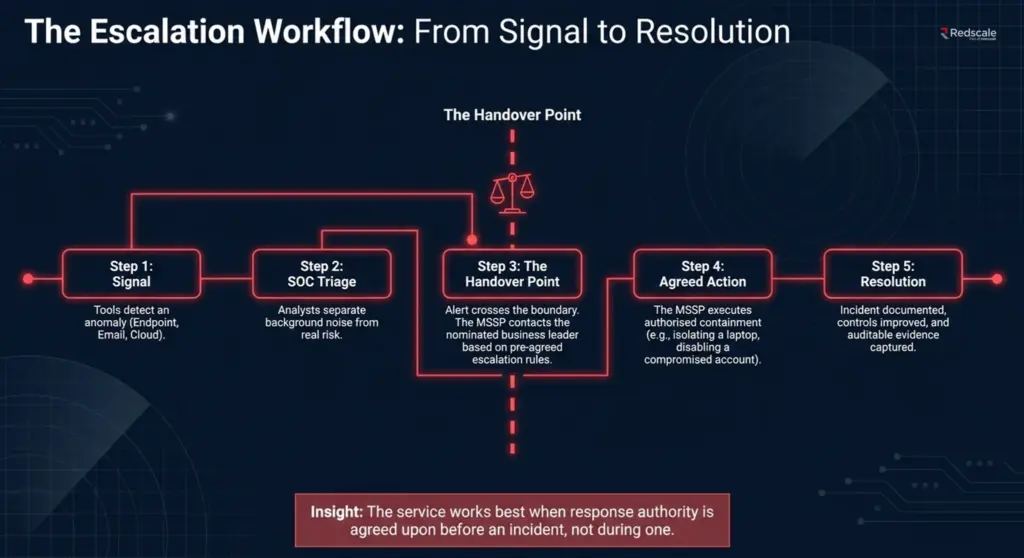
Managed security services work by connecting your business environment to a defined security operating model. That model should explain what is monitored, what is reported, and how escalation works. A practical managed security workflow usually looks like this:
- Review the environment: Map users, systems, devices, and current controls.
- Define the scope: Agree what the MSSP will monitor and manage.
- Connect the tools: Configure endpoint, identity, email, cloud, and logging sources.
- Set escalation rules: Decide what triggers action and who must be contacted.
- Monitor and investigate: Review alerts and separate noise from real risk.
- Respond and report: Take agreed action, document findings, and improve controls.
The service works best when the business agrees to response authority before an incident, not during one.
The strongest services are clear about boundaries. If the provider cannot explain what is included, what is excluded, and what happens during escalation, the buyer should slow the conversation down.
What is the Difference Between an MSSP and an MSP?
An MSSP focuses on cybersecurity operations, while an MSP (Managed Service Provider) focuses on general IT management and support. Let’s break down.
| Decision area | MSSP | MSP |
| Main role | Manages cyber risk, detection, and response | Manages IT support, systems, and availability |
| Security contribution | Improves visibility, escalation, evidence, remediation, and risk reduction | Supports security through patching, backups, access setup, and device management |
| Monitoring | Watches security signals across identity, endpoint, cloud, and email | Monitors uptime, devices, tickets, and IT performance |
| Response | Investigates threats and escalates or contains agreed risks | Fixes IT issues and restores normal service |
| Buyer question | Who protects, investigates, and proves security control? | Who keeps our IT running day to day? |
The two can work together, but they are judged by different outcomes. An MSP helps keep technology reliable, while an MSSP helps the business detect, respond to, and prove security control.
What is the Difference Between an MSSP and MDR?
An MSSP provides broader managed cybersecurity support, while MDR (Managed Detection and Response) focuses mainly on detecting and responding to active threats.
| Decision area | MSSP | MDR |
| Main role | Broad managed cybersecurity support | Active detection and response |
| Scope | Covers monitoring, vulnerability, compliance, reporting, training, and advice | Focuses on detecting, investigating, and containing active threats |
| Response ownership | Helps define escalation, evidence, remediation, and ongoing security ownership | Helps investigate threats and contain agreed risks |
| Compliance role | Supports control evidence, reporting, and maturity uplift | May provide incident and threat evidence, but usually not broad compliance support |
| Best fit | Businesses needing wider security ownership | Teams needing stronger detection and response coverage |
MDR may be enough when governance, compliance, and remediation ownership already sit clearly inside the business.
An MSSP is usually a better fit when the business also needs vulnerability management, compliance support, reporting, awareness training, and ongoing security advice.
Do Small and Medium Businesses Need Managed Security Services?
Small and medium businesses need managed security services when security has become too important or too complex to manage informally.
That gap usually becomes visible when the business cannot answer a customer review, insurance renewal, or incident response question with confidence.
💡 For reference, 2024-2025 ASD’s ACSC report confirms more than 84,700 cybercrime reports in FY2024-25, averaging one report every six minutes. The same fact sheet lists average self-reported cybercrime costs of $56,600 for small businesses and $97,200 for medium businesses.
Those figures do not mean every SMB needs the same service level. They do show why security coverage should be treated as a business decision.
Australian cybercrime reporting and cost data show why security coverage has become a business decision, not only an IT concern.
We suggest you test whether your business can monitor, respond, and prove control ownership with the resources it already has.
Can Your Business Afford an In-house Security Team?
An in-house security team can be difficult for SMBs because security requires several skill sets. Monitoring, response, vulnerability management, cloud security, compliance, and awareness are different areas of work.
For example, when you hire one person, you may still leave gaps. That person can quickly become responsible for tools, alerts, policies, audits, incidents, reporting, and internal questions.
Managed security services can be more practical because the business buys access to a broader operating model. It is not the same as having a full internal team, but it can give stronger coverage than one overstretched person.
Can You Cover Threats Outside Business Hours?
Your business can only cover threats outside business hours if someone is actively monitoring alerts, authorised to escalate issues, and able to guide response when staff are offline.
The dilemma is only that plenty of small businesses do not have that coverage without stretching internal staff.
This matters when your systems, accounts, email, customer data, and payment workflows remain active after the workday ends. Most cloud-based SMBs fit that pattern.
A suspicious login, phishing compromise, or malware alert can begin at night, during a weekend, or over a public holiday. Without monitoring and agreed escalation, the first clear sign may arrive too late, or the provider may see the risk but be unable to act.
Do You Have Security Expertise In-house?
You have security expertise in-house only if someone can assess risk, tune controls, investigate alerts, and guide responses with confidence. Knowing which tools are installed is not enough.
Many SMBs have capable IT owners, but those people are often stretched across support, SaaS, devices, vendors, access, and operations. Security then becomes another task competing for attention.
An MSSP can help by taking ownership of defined security activities. The internal team stays involved, but it no longer has to carry every security decision alone.
How Do Managed Security Services Support Compliance?
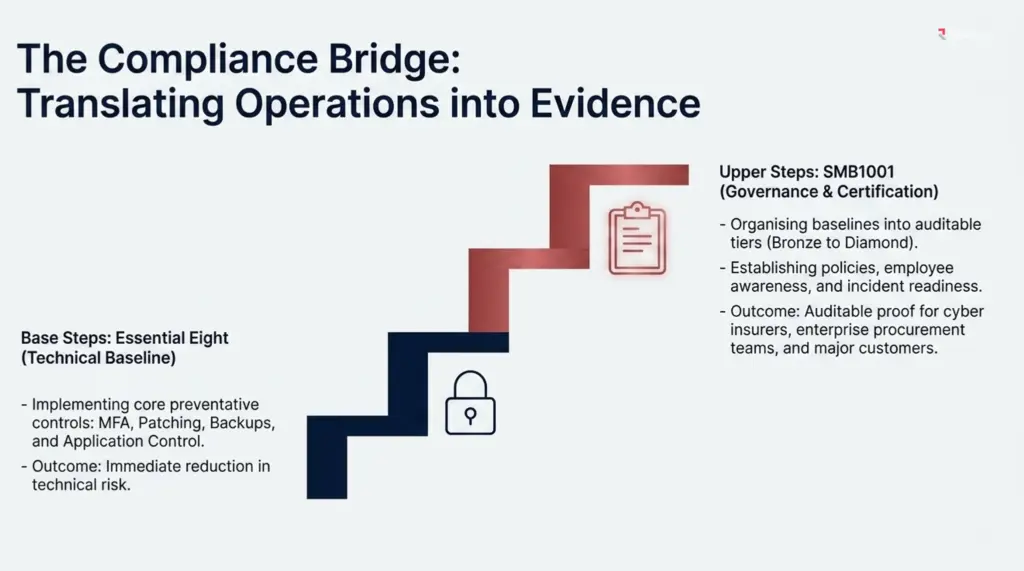
Managed security services support compliance by helping Australian SMBs maintain controls, collect evidence, and respond more confidently when customers, insurers, or partners ask security questions.
For many Australian businesses, the two most practical compliance reference points are the Essential Eight and SMB1001.
The Essential Eight helps organisations improve key technical controls. ASD positions the Essential Eight as a practical baseline for improving cyber resilience, not a complete answer to every cyber threat.
Meanwhile SMB1001 support can give smaller and growing businesses a staged way to organise baseline security maturity, evidence, and certification readiness.
Managed security services can help make compliance with the Essential Eight or SMB1001 easier to maintain because the work is not treated as a one-off checklist. The table below shows how managed security services can support both frameworks.
| Compliance are | How managed security services can help |
| Essential Eight uplift | Support MFA review, patch visibility, privileged access checks, backup evidence, and control improvement. |
| SMB1001 readiness | Help organise baseline controls, evidence, gaps, ownership, and staged maturity actions. |
| Customer security reviews | Prepare clearer evidence for questionnaires, supplier reviews, procurement checks, and insurer discussions. |
| Incident response evidence | Document escalation paths, incident logs, response actions, and post-incident recommendations. |
| Ongoing control ownership | Track who maintains each control, what has changed, and what still needs remediation. |
How Much do Managed Security Services Cost in Australia?
There is no exact figure because managed security services in Australia are usually priced according to scope, users, devices, tooling, coverage hours, and response expectations. But the table below can be your reference for managed security services costs in Australia.
| Service level | Planning range | What it may include |
| Lighter managed security engagement | A$1,000–A$4,000 per month | Security review, basic monitoring, reporting, vulnerability guidance, and advisory support. |
| Broader managed security coverage | A$4,000+ per month | 24/7 monitoring, monitored tooling, analyst review, vulnerability management, compliance reporting, and response support. |
Once the scope includes monitoring, evidence, and response expectations, cost becomes a scoping question rather than a simple licence price. For early budgeting, Australian SMBs can usually think about managed security in two broad categories.
However, these are planning ranges only, not a RedScale quote or a published industry benchmark. The actual cost should be scoped against your environment, risk profile, and required response coverage.
How to Choose a Managed Security Service Provider in Australia
You can choose a managed security service provider in Australia by testing whether they can explain risk, response, reporting, and accountability in plain language. We suggest you use these questions during the buying conversation:
- What systems will you monitor?
- What alerts trigger escalation?
- Who do you contact after hours?
- What response actions are included?
- What reports do we receive?
- Can you help us respond to customer reviews or insurer questionnaires?
- What remains our responsibility?
- How do you protect your own access?
The answers should feel operational. If the provider only talks about tools, ask again about ownership, escalation, and evidence.
ASD’s ACSC publishes guidance for organisations engaging managed service providers, including risks related to provider access and questions organisations can ask before trusting a provider with customer systems.
For Australian SMBs, local context also helps. You want a provider that understands ACSC guidance, Australian cyber insurance questionnaires, customer due diligence, procurement expectations, and the reality of small internal teams.
Secure Your Business With Managed Security Services From Redscale
Most Australian SMBs struggle with security because no one owns the monitoring, escalation, evidence, and response.
When a customer asks for proof, an insurer asks for controls, or an after-hours alert needs a decision, you pay for that gap fast if no one steps up to act. You can’t run security as someone’s spare-time job once your business depends on cloud systems, customer data, and trusted access.
Redscale offers managed security services that turn that scattered responsibility into a dedicated function. As a Melbourne-based provider, Redscale gives Australian SMBs continuous monitoring and faster detection, backed by a defined response process and a team that owns it every day.
Contact us today to build a managed security function around your business.
FAQ
Is Managed Security the Same as Cybersecurity?
Do I Need a Managed Security Provider if I Already Use Antivirus and a Firewall?
Are Managed Security Services Worth It for a Small Business?
How do I Get Started With Managed Security Services?
How Does RedScale Deliver Managed Security Services for Australian SMBs?
Sources
- Annual Cyber Threat Report 2024–25 Fact Sheet (ACSC). ASD’s ACSC. Accessed 30 June 2026. https://www.cyber.gov.au/sites/default/files/2025-10/Annual%20Cyber%20Threat%20Report%202024-25%20factsheet%20for%20businesses%20and%20organisations.pdf
- Essential Eight Maturity Model (ACSC). ASD’s ACSC. Accessed 30 June 2026. https://www.cyber.gov.au/business-government/asds-cyber-security-frameworks/essential-eight/essential-eight-maturity-model
- Managed Service Providers Guidance (ACSC). ASD’s ACSC. Accessed 30 June 2026. https://www.cyber.gov.au/business-government/supplier-cyber-risk-management/managed–service-providers