Cybersecurity awareness is the ongoing process of helping your team recognise cyberthreats, understand how to avoid them, and know what to do if something goes wrong. It builds a habit of taking responsibility for your business’s data and systems. In plain terms, it means knowing what the risks look like and acting on that knowledge.
If you’ve been wondering what cybersecurity awareness means for your business, you’re in the right place.
In this article, we explain what cybersecurity awareness means and what a program includes. We also walk through how it’s measured and how it connects to compliance and cyber insurance in Australia.
What Is Cybersecurity Awareness?
Cybersecurity awareness is the knowledge and judgement your business needs to recognise digital threats and respond to them correctly. It applies to everyday actions across your business, such as opening an email or logging into a work account.
Two elements make up cybersecurity awareness: recognition and action. Recognition means someone in your business noticing something is wrong, such as an unexpected login prompt or an unfamiliar invoice. Action means knowing the correct next step, such as reporting a suspicious email or verifying an unexpected request.
Cybersecurity awareness is not a single training session you run once. It is an ongoing state of knowledge that your staff carry day to day. Training builds this state. Awareness is the outcome your business relies on.
The term applies beyond your IT setup or provider. Anyone on your payroll using email or a company device carries some level of cyber risk. Cybersecurity awareness applies across your whole business, not a technical few.
It also extends past phishing emails. The same judgement applies beyond email, including phone calls and in-person requests for access to your systems.
What Does a Cybersecurity Awareness Program Include?
A cybersecurity awareness program usually includes training sessions, phishing simulations, ongoing reinforcement, and incident reporting drills.
These programs help employees recognise, avoid, and report security risks.
These cybersecurity awareness programs work best when they are connected:
- Training explains the risk
- Simulations test real-world judgement
- Reinforcement keeps security visible
- Reporting drills show employees what to do when something feels suspicious.
Security Awareness Training Sessions
The security awareness training sessions give employees a clear foundation for the security decisions their roles require.
- Phishing
- Credential protection
- Data handling
- Social engineering
- Safe cloud use
- Device security
- Incident reporting.
They should also explain company-specific processes, such as where to report a suspicious message or how to verify a payment request.
We believe shorter and focused sessions are often easier to apply than a long annual presentation.
New starters also need training early because they may receive access to email, customer information, shared applications, and internal documents before they understand the organisation’s processes.
Phishing Simulations
Phishing simulations test how employees respond to controlled examples of deceptive messages.
This phishing simulation can reveal many aspects from your staff, like:
- Whether staff recognise warning signs
- Use the correct reporting mechanism
- Whether need more context
- Support learning without embarrassing employees
- Creating a leaderboard of failure.
We believe Australian business in 2026 should test more than conventional email phishing. According to the 2026 Verizon Data Breach Investigations Report, email phishing simulations had a median click rate of 1.4%.
Simulations using phone-centric methods, including text messages, voice calls, and callback-focused emails, recorded a median rate closer to 2%.
That difference represents a 40% increase in the median click rate, although Verizon cautions that the sample sizes differ.
The finding still gives businesses a practical reason to include voice, SMS, and callback scenarios where employees regularly use those channels.
As a simulation, the point is not simply to compare which channel gets more clicks. These exercises are more useful when they show how people interpret suspicious requests across the channels they actually use at work.
Ongoing Reinforcement
Ongoing reinforcement keeps relevant security behaviours visible between formal sessions.
This can include short reminders, team-specific examples, brief videos, manager prompts, and micro-content linked to current work. The material should address a defined behaviour rather than repeat generic warnings.
A reminder before a major system migration may focus on false login pages. Guidance before a holiday period may address payment changes, unusual supplier requests, or unattended devices.
Reinforcement works best when it is timely and specific.
Incident Reporting Drill
An incident reporting drill tests whether your staff know how and when to raise a security concern.
In many cases, employees need a reporting route that is simple, visible, and safe to use.
They should know what information to include and what immediate actions to avoid, such as deleting evidence or continuing to interact with a suspicious sender.
A drill can expose delays that ordinary training misses. It may show that employees cannot find the reporting button, do not know whom to contact after hours, or fear blame for reporting a mistake.
The organisation then has something concrete to improve.
How Do You Measure Cybersecurity Awareness Program Effectiveness?
Cybersecurity awareness program effectiveness is usually measured through training completion rates, phishing simulation report rates, and incident reporting volume.
These measures should show whether employees are participating, recognising suspicious activity, and using the right reporting paths.
Training Completion Rate
Training completion rate shows whether the intended audience received the assigned material.
It is useful for tracking coverage and identifying missed teams, contractors, or new starters. Completion does not show whether someone understood the material or can apply it under pressure.
Combine it with short knowledge checks, practical exercises, and manager follow-up. The goal is adequate coverage with evidence of comprehension, not a perfect dashboard number.
Phishing Simulation Report Rate
The phishing simulation report rate shows how often employees report a simulated message through the correct channel.
This can be more informative than the click rate because early reporting gives the security team a chance to investigate and warn others. Review the speed and quality of reports as well as their volume.
Results should be assessed by scenario and role. A convincing supplier-invoice simulation presents a different challenge from an obvious password-reset message, so direct comparisons can mislead.
Incident Reporting Volume
Incident reporting volume shows how frequently staff raise suspected security events or mistakes.
An increase does not automatically mean security has become worse. It may show that employees are more confident, the reporting path is easier to use, or previously hidden events are now visible.
Review whether reports arrive quickly, contain useful detail, and reach the right owner.
Over time, examine which issues repeat and whether the organisation changes training, controls, or workflows in response.
Measurement should lead to action. Otherwise, the program produces records without improving decisions.
Why Does Cybersecurity Awareness Matter for a Business?
Cybersecurity awareness helps your business and employees recognise and report risky activity that technical controls do not resolve on their own.
💡 As context, Verizon’s 2026 Data Breach Investigations Report (DBIR) shows the prominence of vulnerability exploitation growth:
- Third parties were involved in 48% of breaches, up from 30% in the previous report.
- Exploited vulnerabilities accounted for 31% of initial access, making them the most common entry vector.
- Credential abuse fell to 13% after previously holding the leading position.
- Phishing remained responsible for 16% of initial access.
- Pretexting reached 6% across all breaches.
- Ransomware appeared somewhere in the attack chain in 48% of breaches.
These figures reinforce an important boundary. Cybersecurity awareness cannot replace:
- Patching
- Access controls
- Multi-factor authentication
- Endpoint security
- Supplier oversight
- Tested incident response.
That’s why vulnerability assessment gives businesses a technical way to find and prioritise weaknesses that cybersecurity awareness training alone cannot fix.
Awareness supports those controls by helping employees recognise when something around them is wrong.
For example, a staff member may question an unexpected MFA request, report a suspicious login page, challenge an unusual payment instruction, or escalate a supplier message that does not follow the agreed process.
How Does Cybersecurity Awareness Support Compliance and Cyber Insurance in Australia?
Cybersecurity awareness supports Australian compliance and cyber insurance discussions by reducing human-error risks, contributing useful evidence for SMB1001 certification, and helping show insurers that staff training is part of the organisation’s security program.
It does not replace technical controls or guarantee compliance. Cybersecurity awareness role is to support the evidence, behaviour, and reporting practices that sit around formal security requirements.
Reducing the Human-Error Risks Essential Eight Is Designed to Close
Awareness helps employees use and support Essential Eight controls, although awareness training is not one of the eight strategies.
The Australian Signals Directorate Essential Eight is built around technical mitigations, but those controls still depend on people using them correctly. For example:
- Multi-factor authentication is stronger when employees understand why unexpected prompts matter.
- Patching works better when teams know why update delays create exposure.
- Backup routines are more reliable when staff understand what to report after accidental deletion, ransomware warning signs, or suspicious file activity.
For Australian SMBs, this is where awareness becomes practical.
Cybersecurity awareness helps staff recognise the moments where their decisions affect technical controls, without pretending that training alone satisfies Essential Eight maturity.
Contributing Evidence Towards SMB1001 Certification
Cybersecurity awareness can contribute evidence towards SMB1001 certification by showing that employees:
- Receive security guidance
- Understand common risks
- Know how to report suspicious activity.
SMB1001 requirements may vary depending on the standard version, target tier, and certification process. For this reason, awareness evidence may include:
- Training records
- Completion reports
- Phishing simulation outcomes
- Reporting procedures
- Policy acknowledgements
- Follow-up actions after exercises.
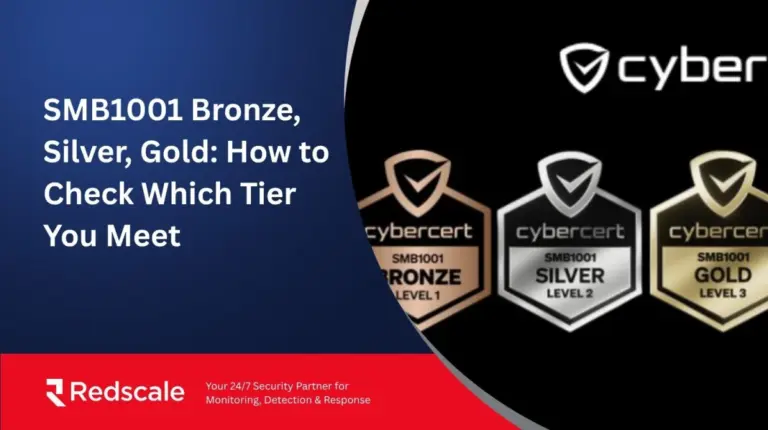
Meeting SMB1001 requirements also means aligning technical controls and governance practices with the tier a business is certifying against.
For Australian SMBs, the value is practical as well as procedural. Awareness activities create a clearer record of how the business manages staff-related security risk.
But they should sit alongside technical controls, governance, access management, backup practices, and other certification evidence.
Meeting Insurer Expectations for Staff Training
Cybersecurity awareness helps meet insurer expectations for staff training by showing that employees are taught to recognise common threats, follow reporting procedures, and reduce avoidable security mistakes.
In many cases, insurers may ask how often staff receive training, what topics are covered, whether phishing exercises are used, and how the business tracks completion.
They may also look for evidence that training connects to wider controls, such as multi-factor authentication, email security, access management, backup processes, and incident response.
For Australian SMBs, cybersecurity awareness matters because cyber insurance reviews increasingly focus on whether security controls exist in practice.
But awareness training does not guarantee cover or lower premiums, but it can help demonstrate that staff risk is being managed as part of a broader cybersecurity program.
How to Build a Cybersecurity Awareness Program for an Australian Business
Build a cybersecurity awareness program by starting with the staff behaviours that create the most risk, then turning those risks into simple training, reporting, testing, and improvement routines.
This approach works because in Australian SMBs, the risk appears in ordinary work.
Let’s say, your staff member approves a payment request, clicks a shared file, responds to an MFA prompt, downloads an attachment, or handles customer data in a cloud system. Use those moments to shape the program.
Step 1 – Identify the Highest-risk Staff Behaviours
Start with the actions most likely to expose the business. These may include clicking suspicious links, reusing passwords, approving urgent payment requests, ignoring MFA prompts, mishandling customer data, or delaying incident reports.
This keeps the program tied to real business risk instead of generic security advice.
Step 2 – Turn Those Behaviours Into Training Topics
Build training around the situations employees actually face.
For Australian startups, SaaS companies, and digital businesses, common topics include phishing, invoice fraud, password management, MFA prompts, shared files, cloud access, device use, and incident reporting.
Short, relevant lessons usually work better than long annual modules.
Step 3 – Create a Reporting Path
Employees should know where to send suspicious emails, who to contact after a mistake, and what information to include in a report.
The goal is to make reporting feel normal and fast. A clear reporting path is often more useful than asking staff to make perfect security decisions on their own.
Step 4 – Test Behaviour in Small and Repeatable Ways
Use phishing simulations, reporting drills, short quizzes, and team reminders to check whether the message is understood.
The goal is not to catch people out. The goal of this behaviour test is to find gaps before they become incidents.
Step 5 – Improve the Process After Each Review
Use the results to improve both training and business processes.
If staff keep responding to fraudulent payment requests, strengthen the approval workflow. If reports arrive late, make the reporting path easier. If training completion is low, adjust the timing, format, or ownership.
Step 6 – Connect Awareness to Wider Security Controls
Cybersecurity awareness should support wider controls such as email security, MFA, vulnerability management, incident response, data loss prevention, Essential Eight uplift, and SMB1001 preparation.
That’s why you need to consider managed security services, as their additional perspective becomes useful.
Because cybersecurity awareness works best when it is part of a managed security routine, not a once-a-year training task.
Build a Security-Aware Culture with RedScale
As you see, awareness gaps usually appear in small moments in your business workflow: a rushed payment request, an unexpected MFA prompt, a shared file from the wrong account, or a suspicious email nobody reports.
These moments need more than a reminder to be careful. Your staff need clear examples, simple reporting paths, realistic practice, and follow-up when the same risks keep appearing.
That’s what RedScale’s cybersecurity awareness training can support.
RedScale’s cybersecurity awareness training helps Australian SMBs cover practical topics such as phishing, suspicious payment requests, MFA prompts, data handling, and incident reporting.
Contact RedScale to build a cybersecurity awareness training program that fits how your team works.